Rachel Folasayo Oladoyin
Game Designer, Level Designer and Artist
Light and Dark Exploration Game
This game is about spreading light in the darkness! You play as a nameless traveller, who radiates light everywhere they go. As the traveller, you're sent around the map, a world covered in darkness, to help different characters find their lost goods, and to uncover an ancient secret. A 2D pixel art game, Light and Dark carries strong themes of perseverance and exploration, in a hub style world.
 |  |  |  |
|---|---|---|---|
 |
Project Duration: 8 months
Team Size: 5 people
Platform: PC
My Roles:
-
2D Character Artist
-
Feature Owner for the Quest 1 Feature
My responsibilities
-
Made concepts for all the characters in the game and presented them to the team for feedback, iterating on the designs until the entire team was happy with them.
-
Made the assets for the characters, which involved single sprites for each of the NPCs, and an animation sheet for the player character.
-
Was part of the brainstorming and project planning process.
Design Process overview
Early process work
Early process work I participated in involved:
-
Making a team charter
-
Making a project charter (which, along with the team charter was a living document and thus updated regularly)
-
Rapid prototyping
-
Performing playtests
-
Iterating on those tests using data we found from observation, questionnaires and telemetries
Later process work
Later process work I participated in involved:
-
Designing and implementing npcs for the game
-
Designing walking animations for the main character
-
Designing a concept for the first quest
Detailed Design Process
Rapid Prototyping
The first thing we did as a group was run multiple small sprints to make prototypes for several different game ideas (rapid prototyping). None of these ideas actually ended up making it to the final game, but they helped us figure out how we worked best as a team, and figure out what we liked and didn't like.
For each sprint, we went through a brainstorming session, a design session, and finally an implementation session, which all together lasted a week.
The brainstorming session involved coming up with a sketch that would guide our design process:

Sketch of the proposed gameplay for the first prototype we made.
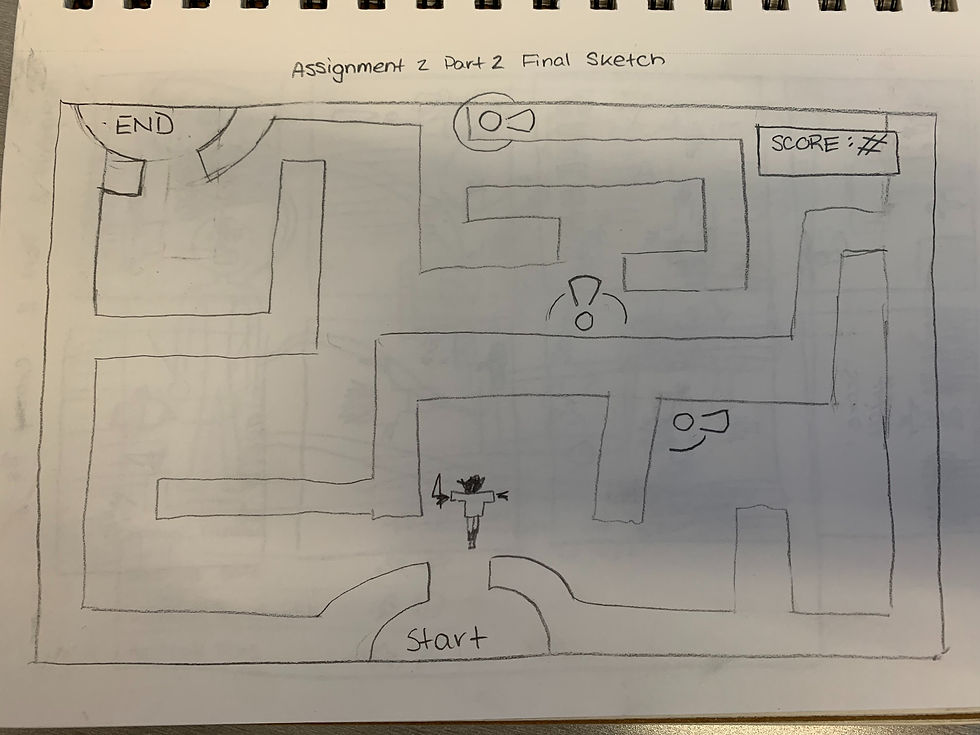
Sketch of the proposed gameplay for the second prototype we made.

Sketch of the proposed gameplay for the third prototype we made.
Sketch of the proposed gameplay for the first prototype we made.
Pictures of our final sketches for each rapid prototype. Click to enlarge, and click the arrows to scroll through.
Then for each project, after the sketches were done, we moved on to developing the design document, which included outlining the player experience in a flowchart, so we knew what experience we were trying to provide for the player.


We outlined the areas we had the most questions about and that we wanted to focus on

Player experience flowcharts for the three different sprints we worked on. Click each picture to enlarge.
After doing all the brainstorming and planning, we made small prototypes for each project in unity. This helped us set the stage for how we would do things in the final project.
Team and Project Charter
After making rapid prototypes, we made a team charter and project charter for the final project. The team charter was where we outlined our roles, responsibilities, workflow, decisions and communication. This was a living document and was updated whenever there were any changes.

Screenshot from the team charter of a flowchart outlining the general workflow we followed for assignment submissions. Click to enlarge.

Screenshot from the team charter of a flowchart outlining our process for decision making. Click to enlarge.
The project charter was where we outlined the vision, goals, audience and features for our project. This was also a living document, and we turned to it whenever we needed to make decisions for our game so we could remember the foundations of our design.

Initial world layout concept from the project charter. From the beginning, we wanted to make a game with a hub-style layout. Click to enlarge.

Initial gameplay loop concept, from the project charter. Click to enlarge.
Playtests
After making the documents, we made a prototype for our game using the same workflow we used in the earlier, smaller sprints. Once we had made a simple prototype, we started playtesting, factoring in the data from telemetries, questionnaires and observations when making iterations.

A screenshot of the player at the checkpoint placeholder in our first playtest build.
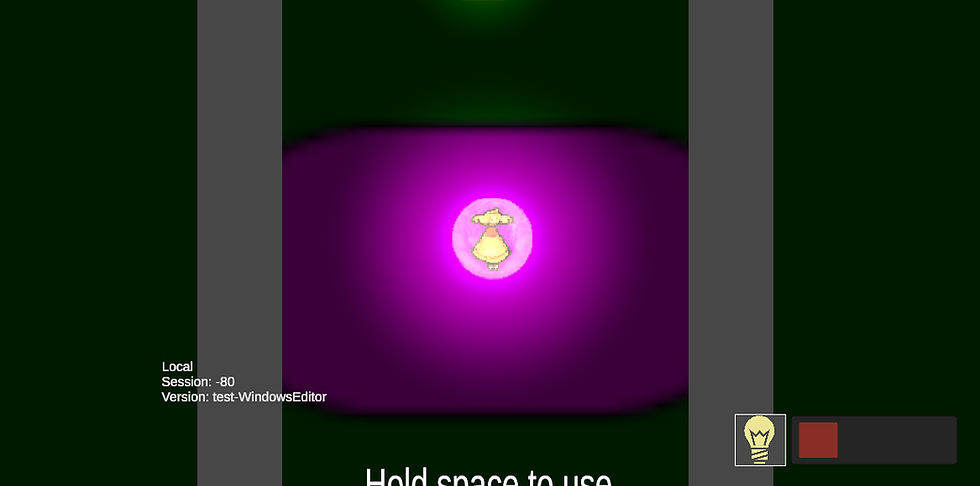
A screenshot of the player at the slow zone placeholder in our first playtest build.
A screenshot of the player at the checkpoint placeholder in our first playtest build.
Snapshots from an early build, used for playtesting. Click to enlarge, and click the arrows to scroll through.
Character Design
The first thing we talked during the later part of the process was designing NPCs and animations for the main character. The onus of this task mostly fell on me as the main artist on the team, so I developed concepts for the characters, consulted the team for feedback, then developed the character sprites. I also made a sprite sheet for the main character.

These were the concepts I initially showed to the team. The designs my team members chose are the ones outlined in red.

I made a lineup of all the supporting characters side by side to make sure they all fit together

These were the final pixelated character sprites, ready to be implemented into the game
These were the concepts I initially showed to the team. The designs my team members chose are the ones outlined in red.

Main character animation sprite sheet. Click to enlarge.
Quest Design
I also had to make an early concept for one of the quests so we could have an idea of how we were gonna move forward with the quests in the game. I simply made a flowchart outlining the player's experience of the quest.

Concept flowchart for quest 1. Click to enlarge.
Gameplay Video
Challenges
One challenge my team and I faced a lot on this project was struggles with not being on the same page. We often had conflicts because of this.
I also personally faced a challenge when designing characters, because I had trouble properly understanding my team's mental models.
Lessons learned
This taught me to more thoroughly explain my thoughts during decision making, and to make sketches when possible so I can effectively share my personal mental models with others on the team.
This taught me to focus on quantity instead of quality when making initial character concepts. I did this so that it'd be more likely that one or more of my concepts would align with my teammates visions. This also saved time, because it meant that I didn't need to scrap a character I may have spent hours on.
I also learned how to properly plan and organize a project. I now know how to do proper documentation for any project I'm working on, and how to do this documentation in a way that's easily communicated to teammates.