Sayo Oladoyin
Game Designer, Level Designer and Artist
Cosmic conquest
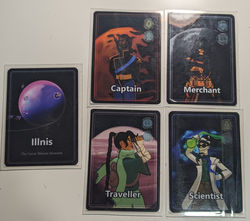
This is a cooperative card game that is based of off matching and trading. It's a 3 player game where players play as different members of a crew and work together to find materials they can each use to save their planet. It is a space-themed strategy game.
 |  |  |
|---|
Project Duration: 4 months
Team Size: 4 people
Platform: Tabletop
My Roles:
-
Game/Systems Designer
-
2D Artist
My responsibilities
-
Added to and edited design documents.
-
Made spreadsheets to document the cards that would be made and the information that would be on each card.
-
Made character designs for the character cards.
-
Conducted playtests and documented feedback.
-
Designed a logo for the game.
Design Process overview
Early process work
Our early design process involved:
-
Researching other wallet card games
-
Designing paper prototypes (first individually, then as a team)
-
Creating a design refinement document
-
Carrying out guided and unguided playtests
-
Making spreadsheet to plan out card information
Later process work
Our later design process involved:
-
Creating final card designs
-
Finalizing the rulebook contents and design
-
Creating a spreadsheet to balance the card values
Detailed Design Process
Research and Early Prototyping
The first thing we did when starting out with this project was researching other wallet card games. None of us had any experience making a wallet card game (or really any card game), so the research was vital to see how the mechanics worked and how reasonably complex gameplay was generally fit into such a small number of cards.
After we all did research, we made our own little paper prototypes of card games individually, then shared them with the team. This started our brainstorming process and allowed us bounce ideas off of each other, and develop a prototype together. Once we had developed a more final prototype, we moved on to the next stage.
Design exploration and refinement
After settling on a prototype to move forward with, the next step in the process was design exploration. Here we answered questions about player heuristics, the proposed gameplay experience, mechanisms, target audience and more, all through the lens of a specific mechanic constraint, which in our case was the mechanic of matching.

Screenshot from the design exploration document about player heuristics. Click to enlarge.

Proposed game experience and target audience from the design exploration document. Click to enlarge.
When we were done with the design exploration document, we moved onto design refinement which involved describing the experience in more detail, creating the rulebook, planning out the cards and performing unguided playtests. We also had a changelog where we updated the refinements we made throughout the refinement process. This was all to get the game to a stage where we would be ready to do some final balancing and polishing.

Documentation of some results from an unguided playtest from the design refinement document that we performed after we had designed an early rulebook. Click to enlarge.

Changelog in the design refinement document we kept to keep track of changes we made throughout the project.. Click to enlarge.
During the early process work, we also made a spreadsheet to plan out the information that we wanted to have on each card, especially so the cards would be easy to design in InDesign. After we finished all these different documents, we were able to move onto the later parts of the design process.
Balancing values
Before we could finalize the card designs and the rulebook, we had to balance the values of the cards with a spreadsheet. We ensured that there was the right amount of each type of card, and that the right text was on each type of card. Because the cards were double sided, we also had to plan out what was on each side of each card. This helped us ensure the gameplay was as balanced as possible.


Each character requires a pair of materials to complete their phase. We outlined which materials each character would need in this column.
We made sure that there were enough cards for each material, so each character would have close to equal chances of gettin gthe cards they need.
Card balancing spreadsheet for side 1 of the cards. Click to enlarge.

Card balancing spreadsheet for side 2 of the cards. Click to enlarge.
Finalizing Card Designs
After we finished balancing all the cards, we finalized the card designs. We took all our illustrations and information and put them together in InDesign to make the final card designs. We then got these cards printed professionally.


Final card designs. Click to enlarge.
Finalizing the Rulebook
While we were finalizing the card designs, we were also finalizing the rulebook. This involved importing it into InDesign, shortening the text to a length that would be able to fit the template we were using, and finalizing the visual style. We were then able to professionally print the rulebook, and then the game was ready to play!
Gameplay Video
Lessons learned
One lesson I learned during this project was to properly communicate any and all changes I want to make to the project, especially if I am not the only person that would have to be involved when implementing the changes.
I also learned that I shouldn't make any extreme last minute changes. Projects should have a deadline after which no extreme changes can be allowed to avoid large amounts of lost work at the end of the project.